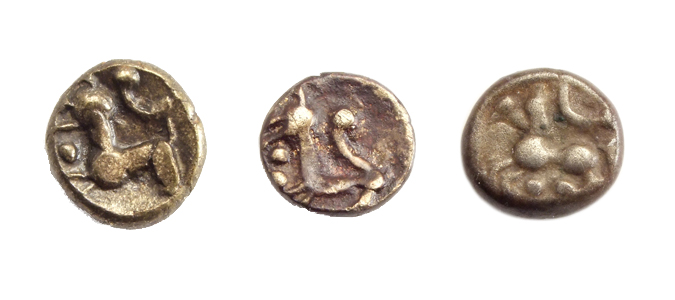
The Celts were not a single people, but a constellation of tribes sharing related languages, art and beliefs across Iron Age Europe. From Britain to Gaul and the Rhineland, many tribes issued distinctive coinages with bold, stylised designs.
The origins of the various Celtic tribes and their relationships remain subjects of debate. Lepontic inscriptions, attested from the sixth century BC, are among the earliest evidence of a Celtic language. Celtic-speaking communities lived across much of western continental Europe, the Iberian Peninsula, Ireland and Britain.
Below, the tribes are grouped geographically into British and Continental communities. Explore their histories, territories and coinage, and click an image to view a larger version.
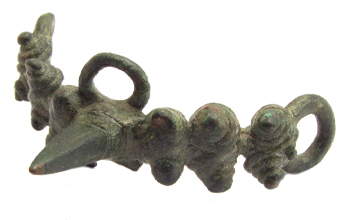
Example of a Celtic bronze prick spur.
British Celtic Tribes
The tribes of Iron Age Britain issued distinctive coins. Their coinage and archaeology illuminate their culture and their encounters with Rome.
Catuvellauni
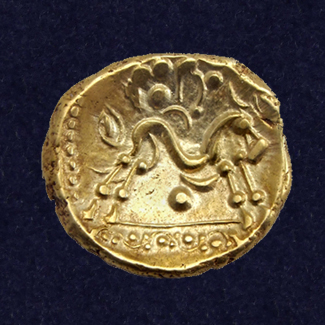
Gold stater of Tasciovanus, a ruler of the Catuvellauni.
Territory and influence The Catuvellauni were a powerful tribe in southern Britain, centred around modern Hertfordshire and Bedfordshire. Known for their advanced economy and skilled metalwork, they were the dominant tribe in south-eastern Britain by the time of the Roman invasion in AD 43.
Rulers and coinage Their rulers, including Tasciovanus and Cunobelinus, issued inscribed coins, marking a shift from purely symbolic imagery to written legends, and played a major role in the politics of late pre-Roman Britain.
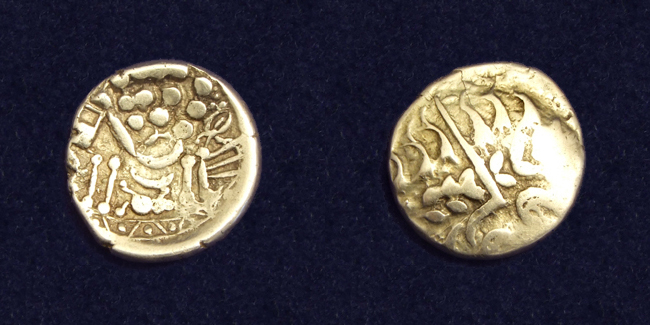
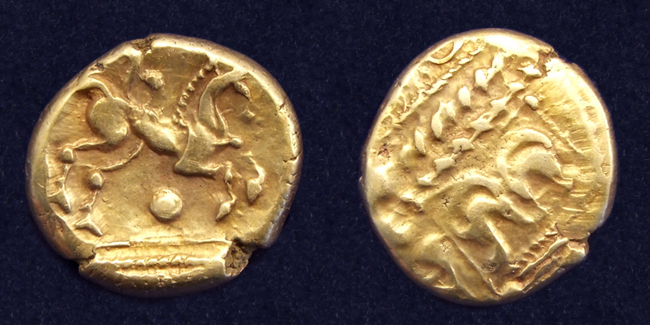
Gold stater, Chute type, traditionally associated with the Durotriges.
Territory and coinage The Durotriges occupied Dorset, southern Wiltshire and southern Somerset. They struck some of Britain's most abstract coinage, with horses and heads reduced to geometric forms. Their coin finds and hillforts reveal a distinctive identity and an active local economy before the Roman conquest.
Metalworking and trade They lived in a mineral-rich area and minted coins well before the Roman invasion. Hengistbury Head was an important centre of metalworking and cross-Channel trade, importing wine, tools and pottery from Gaul and Italy. Metalworking involved gold, silver and copper alloys, bronze casting and the working of local iron ore. Some coins appear to be contemporary imitations with a base-metal core and a silver coating.
Hillforts and Rome Their territory contained an unusual concentration of substantial hillforts, including Maiden Castle and Hod Hill, with South Cadbury Castle in the wider region associated with the tribe. They were bordered by the Belgae to the north and east and the Dumnonii to the west. During the Roman conquest, their region was among those campaigned against by Vespasian and the Second Legion.
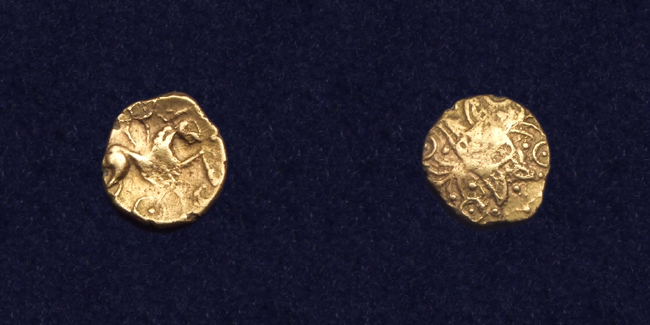
Gold quarter stater attributed to the Iceni, with a stylised horse motif.
Territory The Iceni, also known as the Eceni, were a Celtic tribe of eastern Britain, centred on modern Norfolk and neighbouring parts of East Anglia.
Distinctive coinage Coins attributed to the Iceni were being produced by the middle of the first century BC. Their designs adapted the Gallo-Belgic head-and-horse tradition; on some issues a boar replaces the horse. Some coins carry the inscription ECENI, generally associated with the tribal name.
Boudicca and the Roman conquest The Iceni initially remained allied to Rome after the invasion of AD 43. Following the death of Prasutagus, a pro-Roman Icenian king, his widow Boudicca led a major revolt in AD 60 or 61. The rebels destroyed Camulodunum (Colchester), Londinium (London) and Verulamium, and defeated a force from the Ninth Legion. Boudicca was eventually defeated by the Roman army under Suetonius Paulinus.
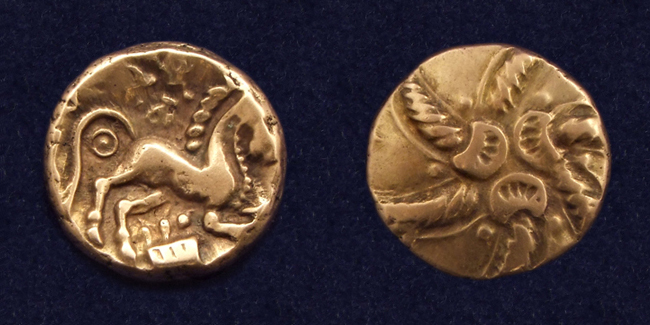
Gold stater, spiral type, attributed to the Trinovantes.Gold stater, Whaddon Chase type, from the North Thames region.
Territory and rulers The Trinovantes occupied territory north of the Thames estuary. They were bordered by the Iceni to the north and the Catuvellauni to the west. Addedomarus was a ruler associated with this region in the late first century BC.
Evidence from coins His name is known from inscribed coins. He was among the earliest rulers to issue named coinage north of the Thames, although the chronology remains debated. Camulodunum (Colchester) became an important centre. Coins of Tasciovanus also bear its name, suggesting a period of Catuvellaunian influence. Addedomarus appears to have been succeeded by Dubnovellaunus towards the end of the first century BC.
Continental Celtic communities linked the Mediterranean and northern Europe. Their coinage, trade and alliances reveal close contact with the Greek and Roman worlds while preserving distinct local styles.
Ambiani
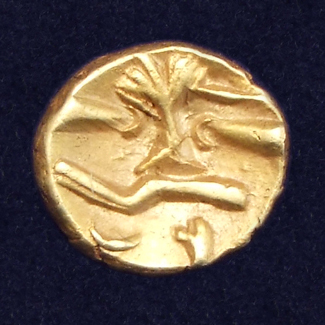
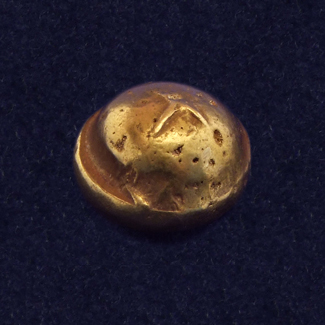
Uniface gold stater attributed to the Ambiani.
Territory The Ambiani were a coastal tribe living along the lower reaches of the Somme in present-day Picardy. Their chief town, Samarobriva, corresponds to modern Amiens.
Gold coinage The Ambiani were prolific coin producers, and their coinage is found across the territories of the Belgic tribes and in Britain. A coin with a stag on one side and a torc-wearing head on the other has been interpreted as possible evidence of an association with Cernunnos, the horned god.
The Gallic Wars Their well-known uniface gold staters, often called "Gallic War staters", circulated widely in northern Gaul and Britain. They are thought to have helped finance warfare, possibly including payments to mercenaries. One interpretation links their blank obverse to rapid wartime production. In 57 BC, the Ambiani joined the coalition of Belgic tribes opposing Julius Caesar.
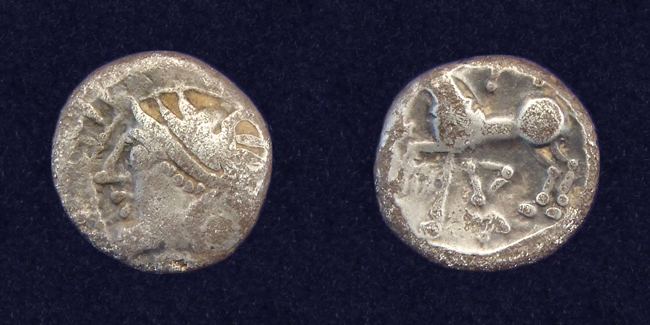
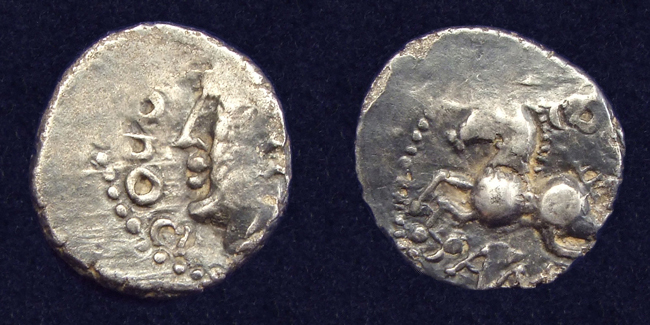
Kaletedou-type silver quinarius, traditionally attributed to the Lingones.
Territory and migration The Lingones occupied a large territory around modern Haute-Marne and parts of Côte-d'Or, Yonne and Aube. Their neighbours included the Senones, Leuci, Remi, Suessiones and Aedui. Their chief town, Andematunnum, is now Langres. Around 400 BC, some Lingones migrated across the Alps to Cisalpine Gaul in northern Italy.
Relations with Rome Their position on routes linking the Mediterranean with western and northern Europe gave their territory considerable economic importance. The Gaulish Lingones were allies of Caesar, alongside the Aedui and Remi. By the first century AD, they were extensively Romanised. During the upheavals of AD 69-70, however, Lingones under Julius Sabinus joined the revolt against Rome alongside the Treveri.
Kaletedou-type silver coins Silver coins traditionally attributed to the Lingones include the Kaletedou series, dating to the late second and first centuries BC. Their obverse shows a helmeted head derived from Roma on Roman coinage; the reverse bears a horse and a legend in Greek letters. Tribal attribution and the interpretation of the legend remain subjects of discussion.
Reverse legend varieties
Type 1: SVLA KA ?????? V.
Type 2: K A ?????? Y.
Type 3: an abbreviated legend, sometimes ???, or traces of a pseudo-inscription accompanied by symbols such as a many-spoked wheel, a pellet within a circle or an inverted delta.
Uniface gold quarter stater traditionally attributed to the Morini, northern Gaul.
Coastal territory The Morini were a Belgic tribe inhabiting the coastal plains and wetlands around present-day Pas-de-Calais and neighbouring areas of northern France and western Belgium. Their coinage and settlements reflect close cross-Channel connections. The later name Flanders is generally linked to a Germanic term referring to flooded land.
Caesar and Alesia Caesar took a particular interest in their coastal territory because it offered a short sea crossing to Britain. Marshes and woodland helped the Morini and neighbouring Menapii resist Roman forces. During the revolt led by Vercingetorix in 52 BC, Caesar records that the Morini were required to contribute 5,000 men to the relief army at Alesia.
Examples of electrum quarter staters attributed to the Remi.
Territory and coinage The Remi were a Belgic tribe of north-eastern Gaul. They occupied parts of the northern Champagne region, including the valleys of the Aisne and its tributaries, the Aire and Vesle. Their chief town was Durocortum, modern Reims. They were known for cavalry and horse-breeding, and their coinage includes electrum staters and quarter staters with animal and equestrian motifs.
Allies of Caesar Under Iccius and Andecombogius, the Remi allied themselves with Julius Caesar during his conquest of Gaul. They remained loyal throughout the Gallic Wars and were among his most consistent supporters.
Gold stater, Gallo-Belgic bullet type, traditionally attributed to the Senones.
Gaul and Italy The Senones were a Gallic tribe based around present-day Sens in the Seine and Yonne region. Some migrated into Italy during the early fourth century BC, settling along the Adriatic coast around Sena Gallica, modern Senigallia.
Conflict with Rome The Italian Senones are associated with the sack of Rome, traditionally dated to 390 BC. Rome expelled them from their Italian territory in 283 BC. In 232 BC, the redistribution of former Senonian land contributed to renewed tensions with other Gallic peoples, preceding the invasion of 225 BC.
The Gallic Wars The Senones who remained in Gaul later opposed Caesar. His account lists a quota of 12,000 Senonian troops for the relief army at Alesia in 52 BC. Their history illustrates the movement of Celtic groups across the Alps and their encounters with Etruscan and Roman communities.
Territory and coinage The Sequani occupied the upper basin of the Arar (Saône), the Doubs valley and the Jura Mountains, in an area corresponding broadly to Franche-Comté and part of Burgundy. Their silver coinage includes quinarii influenced by Roman coin types and denominations.
Changing alliances The Sequani initially enlisted Ariovistus against their rivals, the Aedui, but his growing power subsequently threatened their own territory. Caesar intervened against Ariovistus in 58 BC. The Sequani later joined the resistance led by Vercingetorix.
The relief of Alesia In 52 BC, Caesar records that the Sequani were required to supply 12,000 men to the relief army at Alesia. The Senones were assigned a separate contingent of the same size.
Examples from our collection have been illustrated in articles and reference pages. Explore our Media & Publications page for articles using our Celtic images.
Coin captions follow traditional attributions where appropriate. Tribal attributions and chronologies can vary between catalogues and remain subjects of research.
Nice that you visit our site. Please indicate here which cookies we may place. The necessary cookies do not collect personal data. The other cookies help us to improve the site and your visitor experience. They also help us to inform you about our products. Are you going for an optimally working website including all the benefits? Then tick all the boxes!