Dynasty & Continuity
A ruling family needed to appear secure. Wives, mothers and daughters could connect an emperor with an established house and with its future. Their portraits made those relationships visible.

IMPERIAL WOMEN · PORTRAITS · POWER & MEMORY
A woman’s portrait on a Roman coin could carry far more than a name. It could connect generations of a dynasty, celebrate a marriage, honour a mother or preserve the memory of an empress after her death.
These small objects bring together individual lives and the public image of imperial power. Discover how portraits, inscriptions and reverse designs help us read their stories.
A ruling family needed to appear secure. Wives, mothers and daughters could connect an emperor with an established house and with its future. Their portraits made those relationships visible.
Harmony, piety and motherhood were recurring themes. A portrait of an imperial woman could be paired with a deity or personification that expressed qualities the regime wished to celebrate.
Death did not always end a woman’s coinage. Issues for a deified empress could keep her image in circulation and place her memory within the religious life of the dynasty.
Portraits did not automatically imply formal governing power. Roman women were excluded from the principal civic offices, although imperial women could exercise substantial influence through family, patronage and access to the court.
Identify the woman from the inscription, then look at her hair, dress and headwear. Portraits combine recognisable features with official conventions. A hairstyle can help compare issues, but should be used alongside the legend and coin type.
The reverse may show a goddess, a personified virtue or a ceremonial scene. A female figure is not necessarily another portrait of the empress. Attributes such as a torch, offering dish or cornucopia help identify the subject.
Examples photographed by NumisAntica illustrate the themes below. These are historical reference images; the individual coins may have been sold and are not an indication of current availability.
Wife of Augustus · Mother of Tiberius
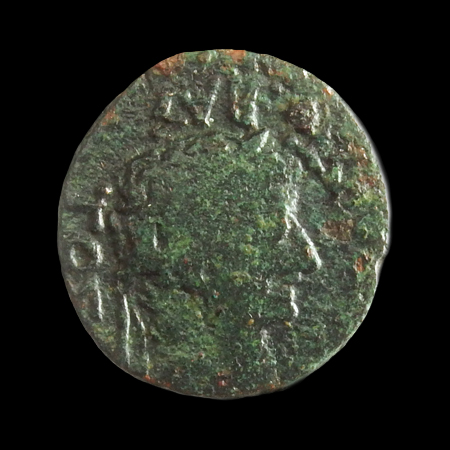
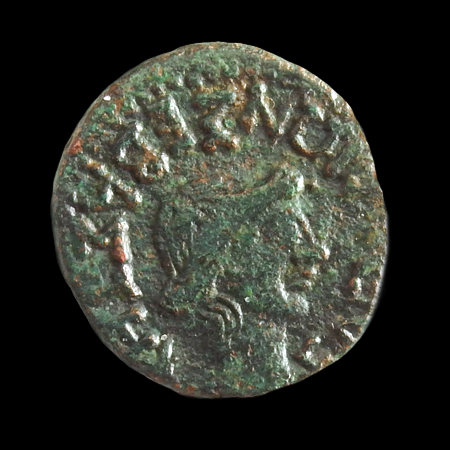
Provincial bronze of Thessalonica: Tiberius on the obverse, Livia on the reverse. NumisAntica photographs.
Livia stood at the centre of the first imperial dynasty. Her marriage to Augustus and her position as the mother of Tiberius linked successive generations of the ruling family. Her public portraits were often idealised rather than records of her appearance at a particular age.
This provincial bronze places Tiberius on one side and Livia on the other. The pairing makes their family relationship visible in a small, widely circulating object. Its Greek inscriptions also remind us that Roman imperial imagery reached communities with their own languages and civic traditions.
The Greek obverse inscription identifies Tiberius Caesar Augustus. RPC records the reverse inscription as S???S?? T?SS???????O?, referring to the Augustan city of the Thessalonians. Read the portrait and the civic legend together.
Further reading: The Metropolitan Museum of Art — Livia · Roman Provincial Coinage — Tiberius and Livia, RPC I 1568
Wife of Hadrian · Augusta by AD 128
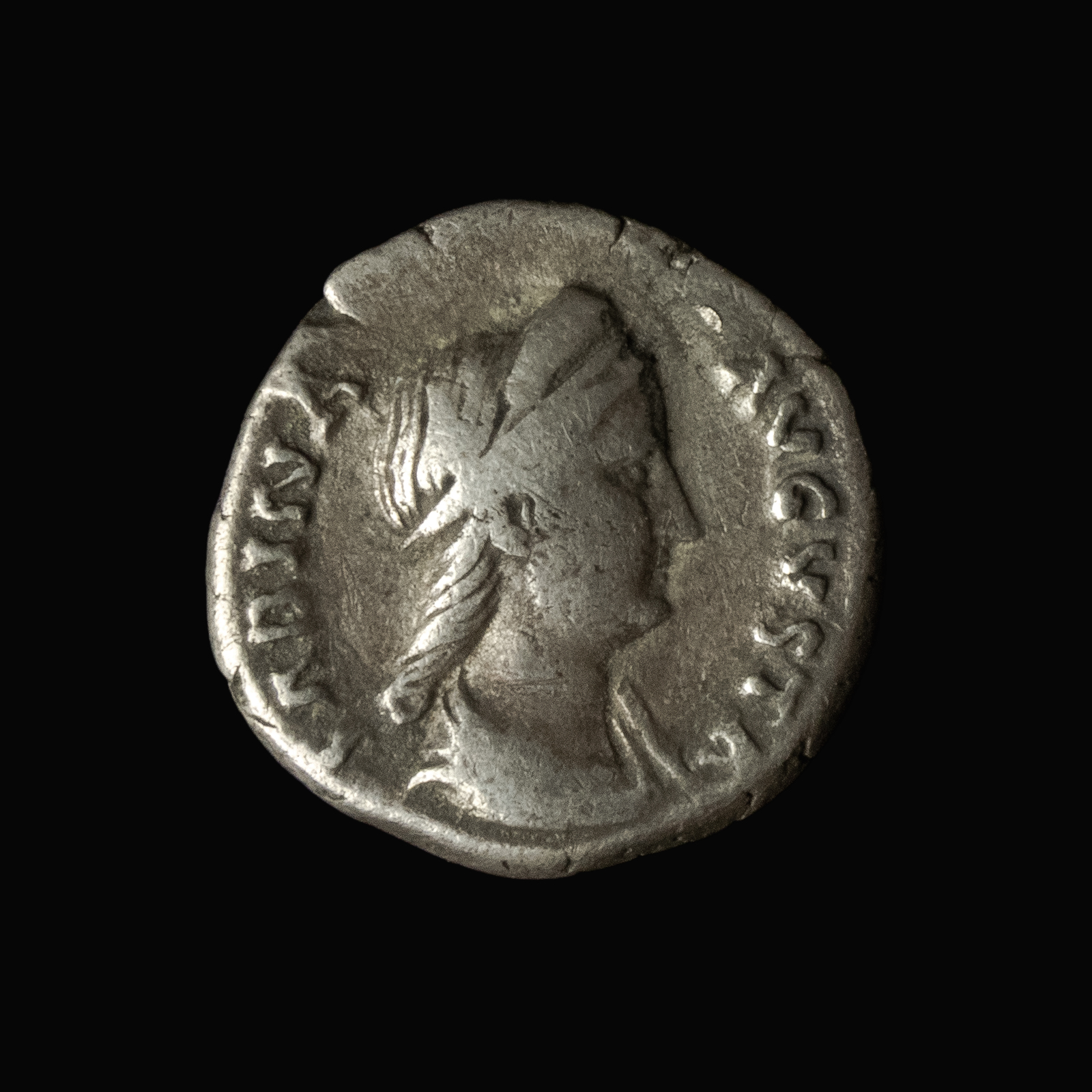
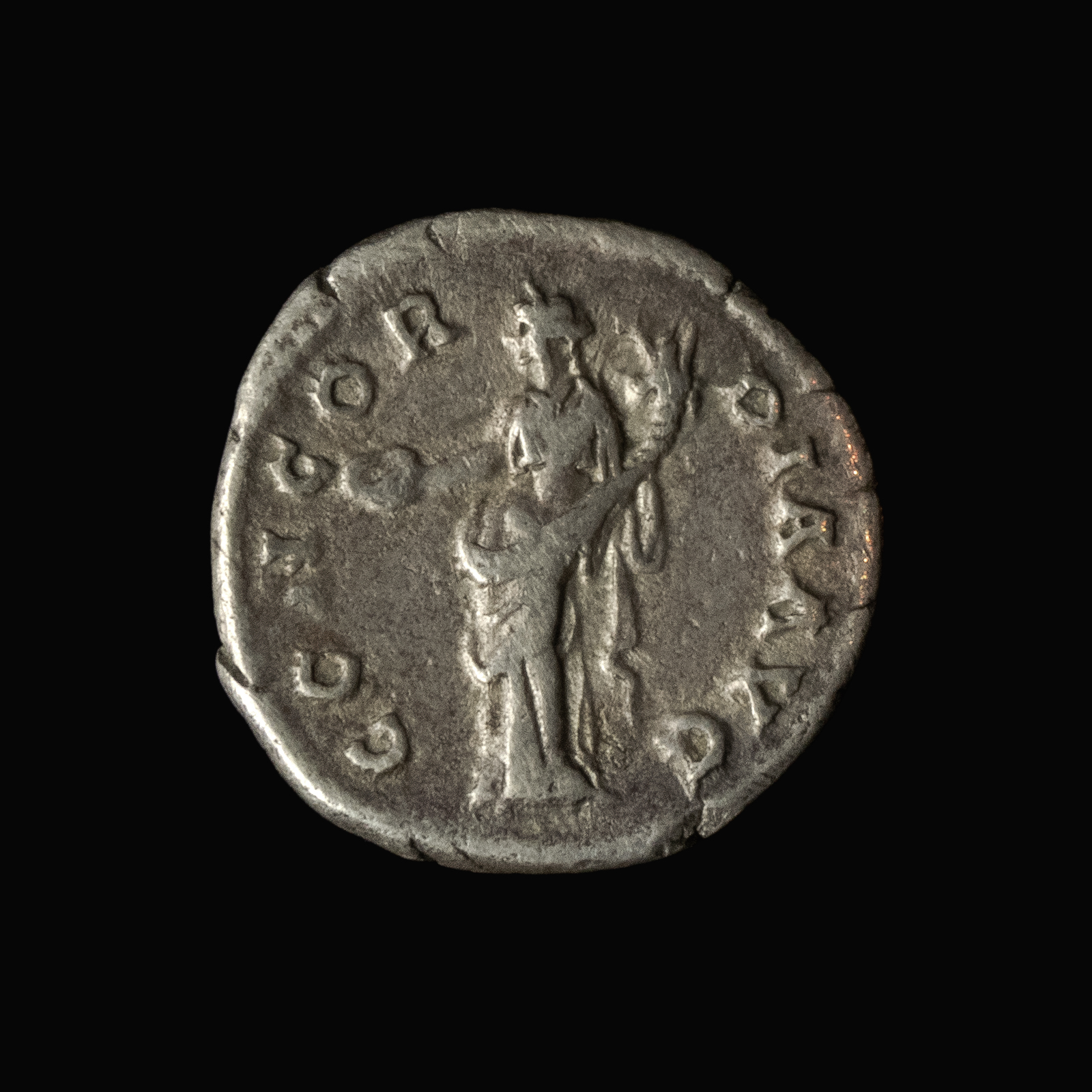
Silver denarius of Sabina with Concordia on the reverse. NumisAntica photographs.
Sabina married Hadrian before he became emperor and accompanied him on imperial journeys, including his visit to Egypt. Her carefully arranged hairstyles changed across her coin portraits, giving collectors another way to compare issues and official images.
The reverse shows Concordia holding a patera, or offering dish, and a cornucopia. Harmony and abundance complement the dignified portrait of the empress. Such imagery expresses the order the imperial household wished to project; it should not be treated as direct evidence of happiness within a private marriage.
SABINA AVGVSTA identifies Sabina with the honorific title Augusta. CONCORDIA AVG associates concord or harmony with the imperial house. The letter V also serves as U in these Latin inscriptions.
Further reading: Oxford Classical Dictionary — Sabina Augusta · Society for Classical Studies — Portraits of Sabina
Wife of Antoninus Pius · Commemorated as Diva Faustina
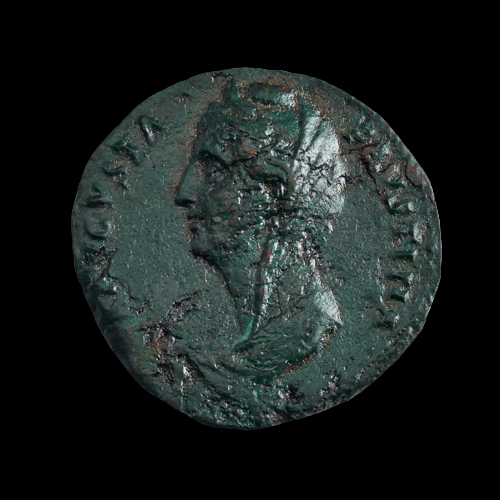
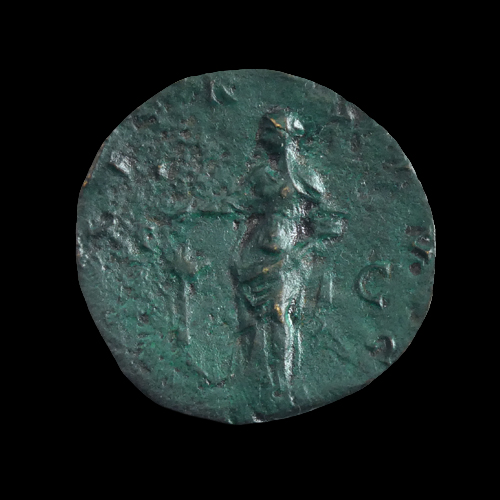
Posthumous sestertius of Faustina the Elder, with a left-facing portrait and Pietas at an altar. NumisAntica photographs.
Faustina the Elder died early in the reign of Antoninus Pius and was subsequently deified. Her image continued to appear on coins after her death. This lasting commemoration linked the emperor with his wife’s memory and with the continuity of the dynasty.
On this sestertius, Pietas makes an offering at an altar. For Roman viewers, piety involved obligations to gods, family and community. The broad bronze coin offers space for both an elaborate portrait and a ritual scene.
DIVA AVGVSTA FAVSTINA identifies the deified Faustina Augusta. PIETAS AVG presents piety in an imperial context. Here DIVA is a crucial clue: this is a commemorative issue, not a portrait struck simply because Faustina was still alive.
Further reading: Uffizi Galleries — Faustina the Elder · British Museum — Faustina and Pietas, RIC III 1146A
Wife of Septimius Severus · Mother of Caracalla and Geta
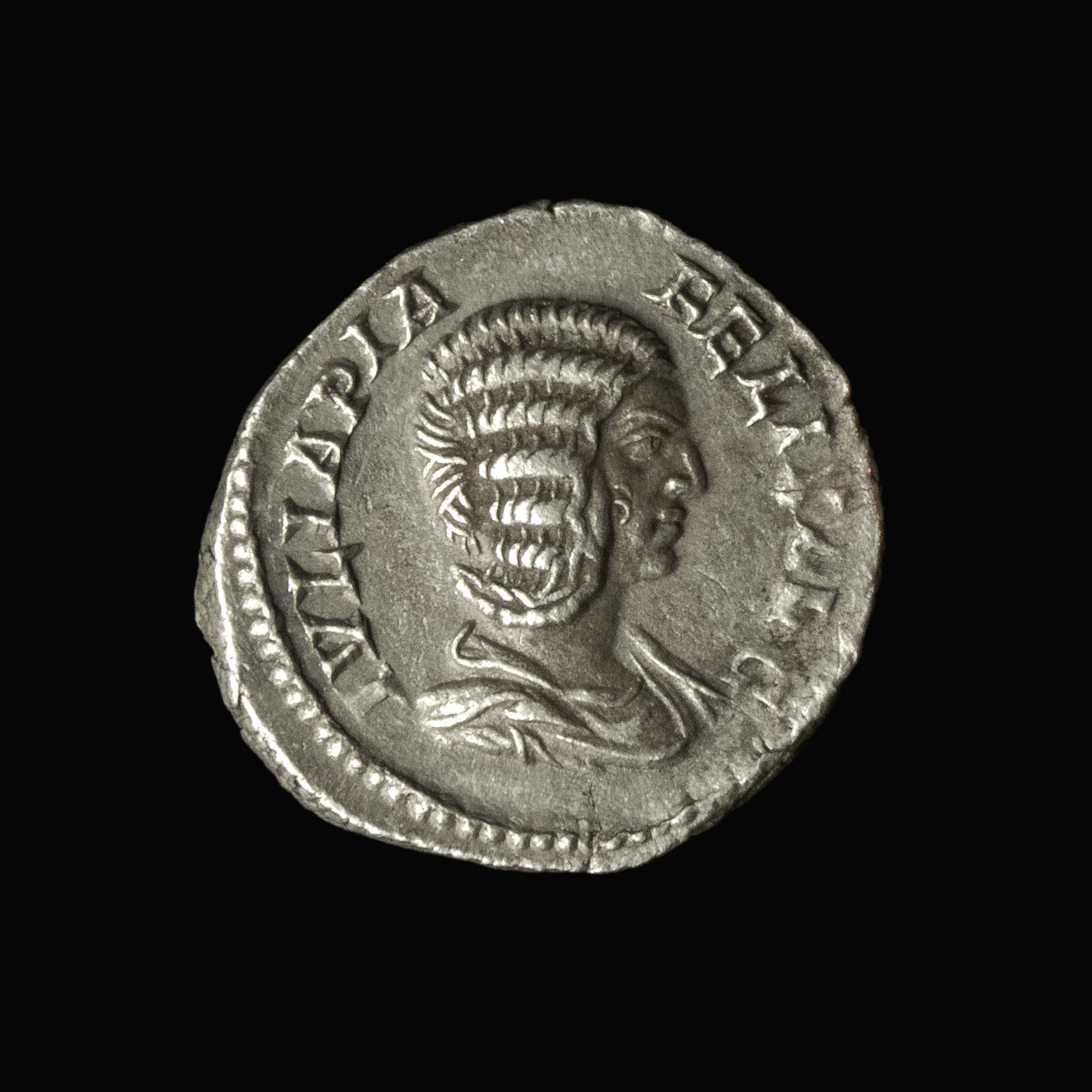
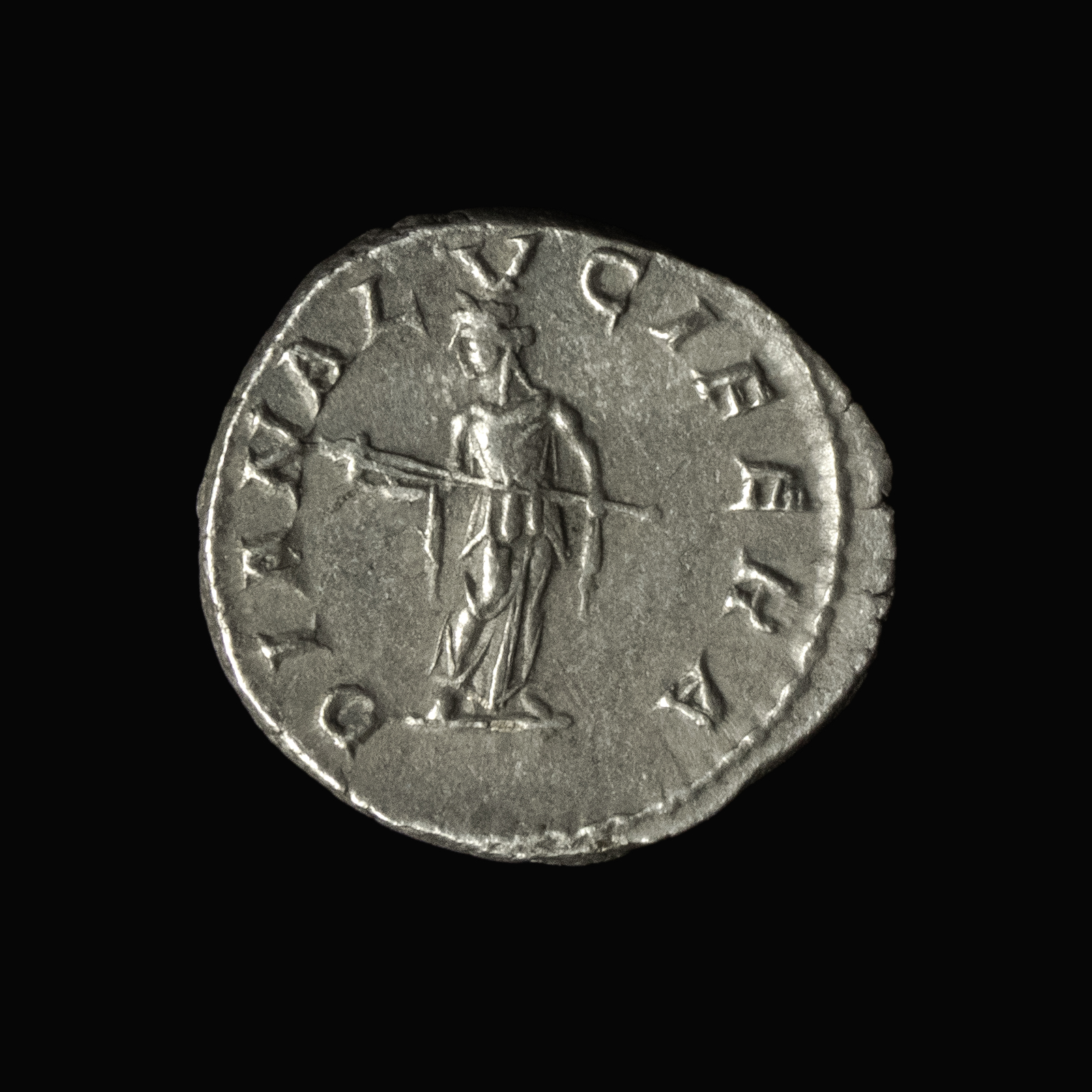
Silver denarius of Julia Domna with Diana holding a long torch on the reverse. NumisAntica photographs.
Julia Domna belonged to a dynasty in which imperial women held considerable informal influence. As the wife of Septimius Severus and later the mother of the reigning Caracalla, she remained a prominent public figure across two reigns. Her coinage is part of that continuing presence.
The reverse depicts Diana carrying a long torch. The inscription names her as the light-bringing goddess. It is Diana, rather than a second portrait of Julia Domna, that appears here: a useful reminder to distinguish a historical woman from a deity on the other side of her coin.
IVLIA PIA FELIX AVG presents Julia with the epithets pious and fortunate, and the title Augusta. DIANA LVCIFERA means Diana the light-bringer. The name, titles and divine imagery form a carefully composed public message.
Further reading: McClung Museum — Femina Princeps
Wife of Caracalla · Married in AD 202
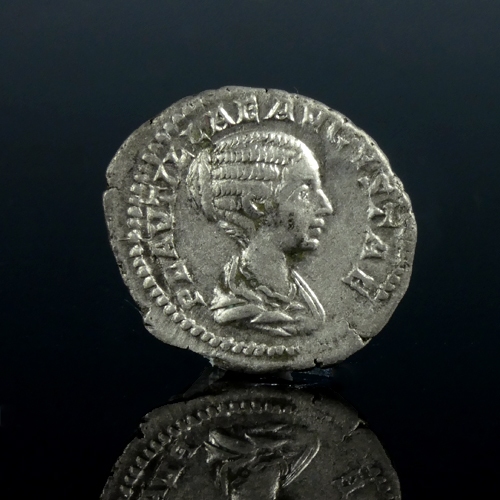
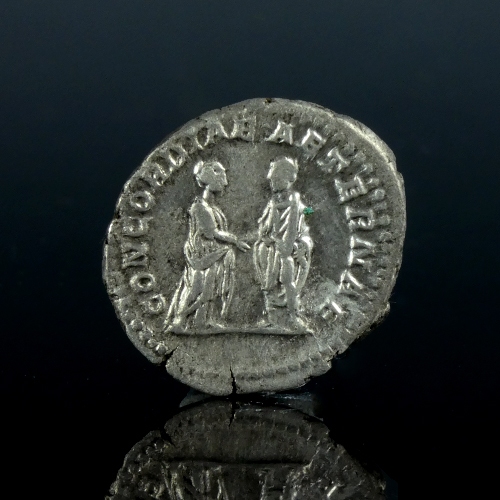
Silver denarius of Plautilla showing the imperial couple clasping hands. NumisAntica photographs.
Plautilla’s marriage to Caracalla in AD 202 placed her within the Severan dynasty. After her father’s downfall in AD 205, she was sent into exile and was later killed on Caracalla’s orders. Her brief public prominence survives in coins that once celebrated the marriage.
The reverse shows the couple joining hands, a visual expression of union. It is especially striking when set beside the later breakdown of Plautilla’s position. A coin can preserve a political promise that events subsequently overturned.
PLAVTILLAE AVGVSTAE names Plautilla Augusta in the dative case. CONCORDIAE AETERNAE means “to eternal harmony”. The inscription records an official ideal rather than a reliable description of the couple’s private relationship.
Further reading: Ostia Antica — Plautilla, with references to Herodian and Cassius Dio
Wife of Aurelian · Late third century AD
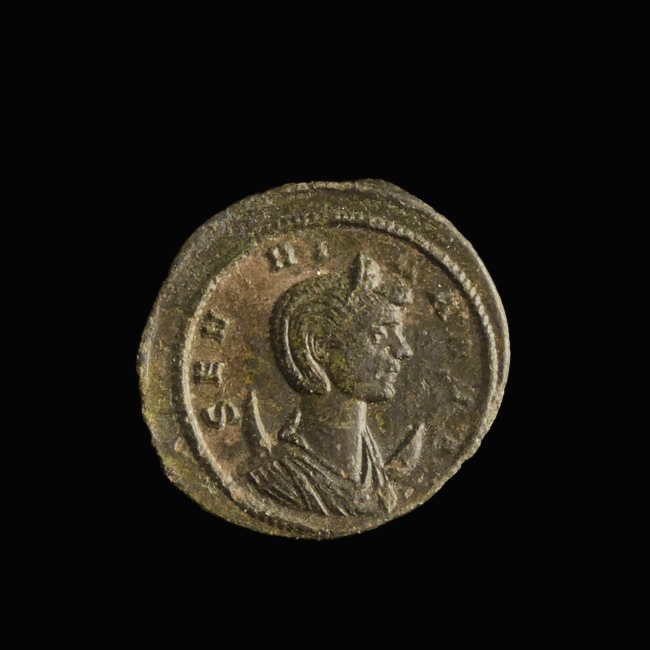
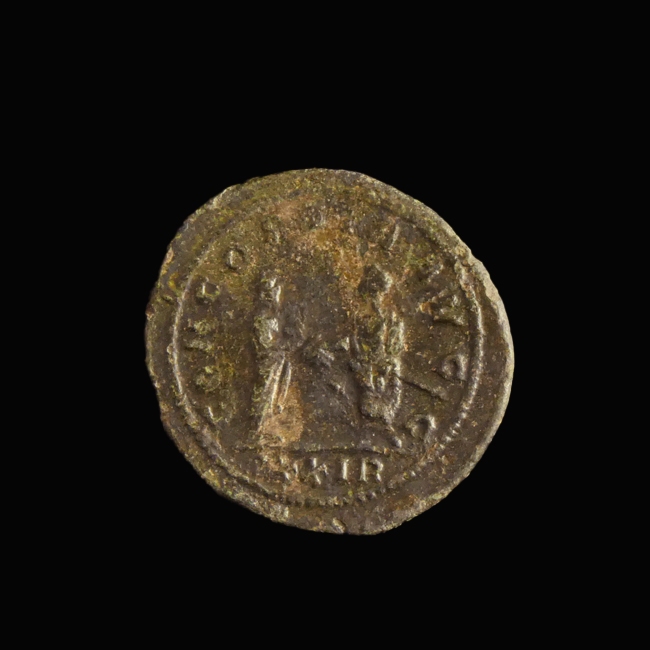
Antoninianus of Severina with an imperial hand-clasp scene on the reverse. NumisAntica photographs.
Severina is less fully documented than some earlier empresses. Her coins therefore provide an important starting point: they preserve her name, portrait and place within the imperial household of Aurelian. They tell us more about her official representation than about her everyday personal life.
This reverse presents an imperial couple joining hands. The scene connects the empress with concord within the ruling house. Beneath her portrait is a crescent, a feature used on many antoniniani of imperial women; it belongs to the denomination’s visual language.
SEVERINA AVG identifies Severina Augusta. CONCORDIA AVGG invokes harmony of the Augusti: the doubled G marks a plural abbreviation. The precise political interpretation needs the issue’s wider context; the inscription alone does not prove that Severina ruled independently.
A coin’s “legend” is its inscription. Abbreviations save space, and Latin often uses V where modern English uses U. The following terms are reading aids; not every example above carries each one.
| Inscription | Meaning | What to Look For |
|---|---|---|
| AVG / AVGVSTA | Augusta | An honorific imperial title; it does not by itself establish a woman’s constitutional powers. |
| DIVA | Deified woman | A posthumous honour. Distinguish it from a lifetime portrait issue. |
| CONCORDIA | Harmony or concord | A personification, a hand-clasp or other imagery of agreement. |
| PIETAS | Piety and duty | Ritual offerings and obligations to gods, family and community. |
| FECVNDITAS | Fruitfulness or fertility | Motherhood and children, with implications for dynastic continuity. |
| LVCIFERA | Light-bringer | A divine epithet, as with Diana and her torch. |
| AVGG | Of the Augusti | A plural abbreviation whose interpretation depends on the particular issue. |
A harmonious reverse does not prove a harmonious marriage, and a youthful portrait does not establish a woman’s age. Coins tell us what an issuing authority chose to present. Personal histories need to be reconstructed from inscriptions, archaeology and written sources as well.
Ancient authors could be hostile towards influential women. Treat sensational stories with care and distinguish documented events from later rumour or interpretation.
Compare women from one ruling family, or follow a single woman through different portrait types. Provincial coins offer another perspective, sometimes placing an emperor and an imperial woman on opposite sides.
Look for themes such as Concordia, Pietas or deification. Compare the inscription with the design, mint and denomination. Condition matters, but a clearly preserved legend or reverse can be especially useful for a historical collection.
McClung Museum – Femina Princeps
The Metropolitan Museum of Art – Livia
Roman Provincial Coinage – Tiberius and Livia, RPC I 1568
Society for Classical Studies – Portraits of Sabina
Oxford Classical Dictionary – Sabina Augusta
Uffizi Galleries – Faustina the Elder
British Museum – Faustina and Pietas, RIC III 1146A
Ostia Antica – Plautilla, with references to Herodian and Cassius Dio
British Museum – Faustina the Younger and Fecunditas
Coin descriptions and photographs: NumisAntica. The glossary and coin interpretations combine the photographed designs with the resources above.