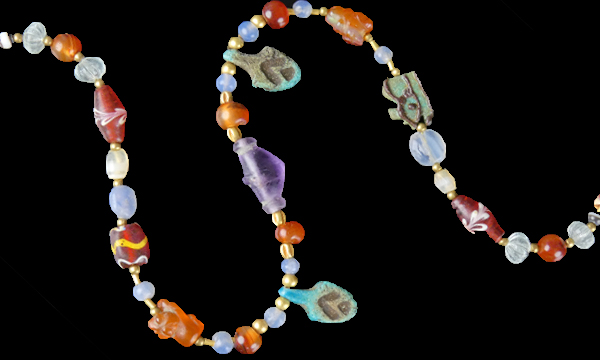
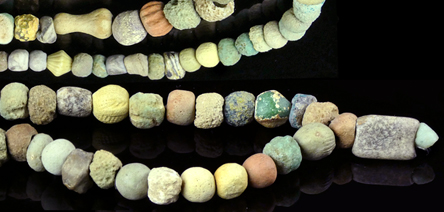
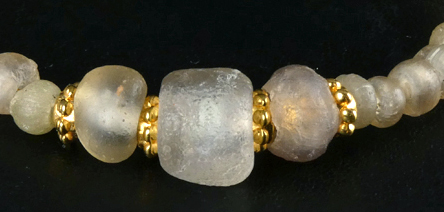
Holding a strand of ancient beads brings you into direct contact with antiquity.
The vibrant colours, diverse shapes, and ancient craftsmanship offer a fascinating
glimpse into the daily lives, trade networks, and personal adornment of early
civilisations.
Ancient materials require mindful handling. These practical guidelines help
protect the unique patina and structural integrity of your wearable history:
Always remove your jewellery before swimming, showering, or physical exercise.
Keep the beads entirely free from direct contact with perfumes, hairsprays,
and lotions.
Protect the piece from sudden impacts or abrasive surfaces.
Clean modern metal components gently with a soft, dry cloth; never scrub or
polish the delicate, weathered surface of the beads.
Store each piece individually in its protective box to safeguard it from
humidity and extreme temperatures.
Please follow any specific instructions provided with your purchase. Feel free
to contact us with any care enquiries.
Ancient Beads, Modern Designs
To bring history back to life, genuine ancient beads are carefully combined
with modern materials to create unique, wearable art. Our local designers use
skin-friendly, nickel-free fittings in gold or silver plate. Jewellery using
the ancient wire-wrapping technique features handmade loops and links that
follow the natural, organic shape of each individual bead. Other designs are
assembled using traditional linking techniques to capture the spirit of
antiquity.
While the finished jewellery is a modern handmade creation,
the ancient beads remain authentic artefacts.
Ancient Techniques, Modern Craftsmanship
Threading beads, shaping wire and joining links were already
part of jewellery-making in antiquity. Surviving ancient
jewellery shows how these methods were used to connect beads,
suspend pendants and create flexible chains. Our contemporary
designs draw on these long-established principles while using
modern materials and fittings.
Stringing & Threading
Passing a cord or thread through pierced beads is one of
the simplest ways to assemble jewellery. Ancient necklaces
and Egyptian beadwork used this principle to arrange beads
into strands, patterns and elaborate collars.
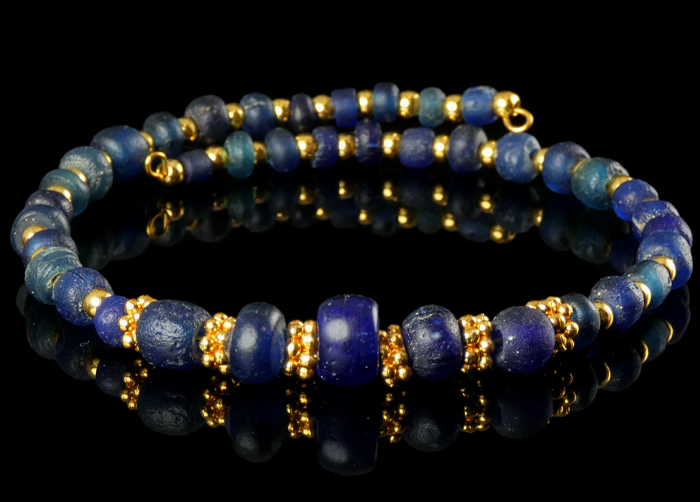
Today, modern stringing materials allow ancient beads to
be assembled into new necklaces and other designs. The
arrangement and supporting materials are contemporary,
while the ancient beads retain their individual character.
Wire-Wrapping & Looped Connections
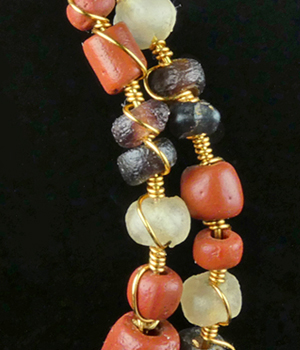
Ancient jewellery makers bent and twisted metal wire to
form loops, secure components and connect decorative
elements. Roman examples preserve both looped wire links
and wire wound around adjoining parts.
Modern wire-wrapping draws on these principles. Wire can
pass through a bead and be shaped into connecting loops,
or be wrapped around a component to hold it in place.
Such connections can be formed without soldering the
individual joint.
Linking & Chain-Making
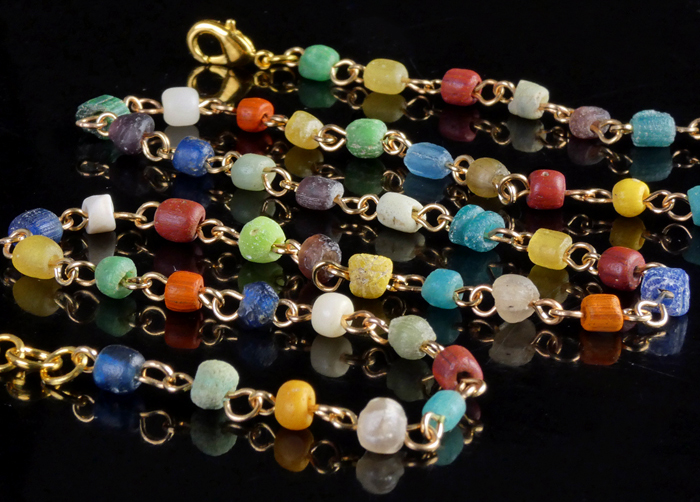
Joining individual metal links was an established craft
in the ancient Mediterranean world. Etruscan and Roman
jewellery includes intricate chains, while Roman bead
necklaces also combine glass beads with gold wire links.
Linked designs connect separate elements into an articulated
necklace or bracelet. Our contemporary interpretations
use handmade connections and modern fittings to combine
ancient beads into a new piece.
Contemporary Flexible Designs
Alongside designs inspired by ancient craftsmanship, our
collection includes modern flexible, clasp-free bracelets.
These use contemporary construction to make the bracelet
easy to put on and remove.
The ancient element lies in the beads themselves. The
flexible construction is a modern design choice, rather
than a reconstruction of an ancient bracelet.
Decoding the History of Ancient Beads
Egyptian Faience
Mastering a Craft Before Glass
Long before true glassmaking emerged, Egyptian artisans developed faience in
the late fifth millennium BC. This complex material required shaping a
quartz-rich body and firing it to fuse a vibrant surface glaze. Over millennia,
it became the defining medium for sacred amulets and status symbols.
The Meaning of Colour
The distinctive blue and turquoise glazes of Egyptian faience were rarely
chosen for mere decoration. These colours mirrored the life-giving waters of
the Nile and the expanse of the heavens, carrying deep spiritual significance
for the wearer.
Apotropaic Protection
Worn by both the living and the deceased, intricate beadwork and woven net
collars served as a protective shield. The precise arrangement of these beads
was believed to invoke divine favour and ward off misfortune.
Roman Glass
An Industrial Revolution
Building upon older eastern Mediterranean core-forming techniques, the Roman
world witnessed a major technological leap with the invention of glassblowing
in the first century BC. This innovation made glass production significantly
faster and transformed a luxury substance into an empire-wide commodity.
Rod Winding and Craftsmanship
To create beads, Roman glassmakers typically wound molten glass around a metal
rod. This hands-on process allowed artisans to manipulate the hot glass, adding
colourful trails, eyes, or marbling to ensure that no two beads left the
workshop identical.
Currency of Cultural Exchange
From the bustling markets of Rome to the remote frontiers of the Empire,
glass beads travelled thousands of miles. They functioned as vital trade
goods, personal adornments, and diplomatic tokens that connected vastly
different cultures.
Understanding Ancient Glass Iridescence
The brilliant, metallic shimmer found on some Roman beads is a product of time
itself. Centuries of burial expose the glass to chemical reactions with surrounding
soil moisture, forming microscopic, layered scales that refract light. This fragile
patina represents a beautiful, natural ageing process and must never be polished
away.
Choosing Jewellery with Ancient Beads
The Character of Each Piece
Ancient beads vary in shape, colour and surface condition.
Some retain a smooth surface, while others show visible
wear, iridescence or weathering. Look closely at the photographs and
condition notes for the particular piece you are considering.
These individual characteristics give each composition its
own appearance. When choosing your jewellery, consider both
the ancient beads and the way they have been arranged within
the modern design.
Size, Fit & Construction
Check the measurements in the product listing, including
necklace length, bracelet diameter and bead size where
provided. Comparing them with jewellery you already own
can help you judge the scale and fit.
Bracelet diameter is not the same as wrist circumference.
Flexible, clasp-free designs also fit differently from
linked bracelets with a clasp. If you are unsure about
the measurements or whether a design can be adjusted,
contact us
before ordering.
Customised for You
To ensure a perfect fit, we collaborate closely with two independent Dutch
jewellery designers. Many of our finished pieces can be tailored in length or
slightly reconfigured to suit your personal style.
Contact us
to discuss your wishes.
Presentation & Authenticity
When size permits, the jewellery will be delivered in a jewellery box with
protective foam. These boxes do not contain tarnish-accelerating chemicals and
are safe for storing your jewellery.
A Certificate of Authenticity in PDF
format is available on request for all our designs with ancient beads.
We use necessary cookies to make this website work. With your consent, we also use preference, statistics and marketing cookies. Select your preferences and click Save.