
Celtic test
Celtic Tribes & Their Coins
The Celts were never a unified empire, but rather a vibrant constellation of independent tribes sharing closely related languages, spiritual beliefs, and art styles across Iron Age Europe. From the shores of Britain to the heart of Gaul and the Rhineland, these communities expressed their distinct identities through remarkable tribal coinages. Unlike the realistic portraits found in the classical Greek and Roman worlds, Celtic money featured bold, highly stylised, and abstract designs that transformed everyday currency into moving pieces of sacred art.
Unravelling the exact origins and shifting relationships of these various tribes remains one of archaeology’s most captivating debates. While some of the earliest evidence of a Celtic language appears in northern Italian Lepontic inscriptions dating back to the sixth century BC, Celtic-speaking communities ultimately left their mark across much of western continental Europe, the Iberian Peninsula, Ireland, and Britain.
To help you navigate this fascinating numismatic landscape, the tribes below are grouped geographically into British and Continental communities. Explore their unique histories, fluid territories, and enigmatic coinages. You can simply click on any image to view a larger archive version.
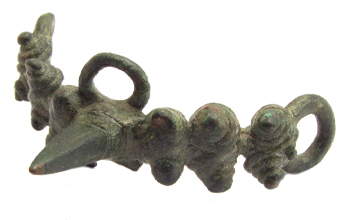
British Celtic Tribes
The tribes of Iron Age Britain issued distinctive coins. Their coinage and archaeology illuminate their culture and their encounters with Rome.
Catuvellauni

Gold stater of Tasciovanus, a ruler of the Catuvellauni.
Dominance in Southern Britain
Centred around modern Hertfordshire and Bedfordshire, the Catuvellauni stood out as one of the most formidable forces in Iron Age Britain. Driven by an advanced regional economy and remarkable metalworking skills, this powerful tribe expanded its territory aggressively, becoming the undisputed dominant power in south-eastern Britain by the time the Romans invaded in AD 43.
The Inscribed Coinage of Kings
Under ambitious dynastic rulers like Tasciovanus and his famous son Cunobelinus, the tribe spearheaded a major monetary revolution. They moved away from purely abstract Celtic symbols to strike coins with written Latin legends, proudly stamping their own names and royal lineages directly into the gold. Famous gold staters minted at Camulodunum, modern Colchester, beautifully combine traditional agricultural symbols like an ear of wheat with striking classical motifs. By incorporating imagery like winged busts reminiscent of Mercury, these spectacular coins show extensive cultural and political contact with the Roman Empire decades before Britain ever became a Roman province.
Durotriges
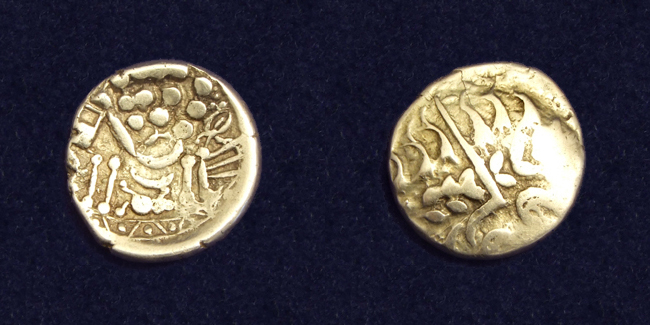
Gold stater, Chute type, traditionally associated with the Durotriges.
Abstract Artistry and Hillfort Strongholds
Occupying a territory across Dorset, southern Wiltshire, and southern Somerset, the Durotriges maintained a fiercely independent identity. They were bordered by the Belgae to the north and east and the Dumnonii to the west. This tribe became famous for an incredible concentration of massive, heavily fortified hillforts, including spectacular strongholds like Maiden Castle, Hod Hill, and South Cadbury Castle. When the Roman invasion swept through Britain, the Durotriges put up a bitter resistance, forcing Vespasian and the Second Legion to launch a brutal and systematic military campaign to subdue their heavily defended hillfort network.
Cross-Channel Commerce and Geometric Money
Long before the Roman legions arrived, the Durotriges thrived on a mineral-rich landscape and an extensive maritime trade network. Coastal trading posts like Hengistbury Head grew into bustling hubs of metalworking and cross-Channel commerce, importing fine wine, pottery, and tools directly from Gaul and Italy. The tribe produced some of Britain’s most extraordinary, avant-garde coinage. Moving away from representational art, their moneyers reduced horses and human heads to beautiful, geometric shapes. Interestingly, as economic pressures mounted or precious metal supplies shifted, they also produced contemporary plated imitations featuring base-metal cores covered with a fine silver coating.
Iceni
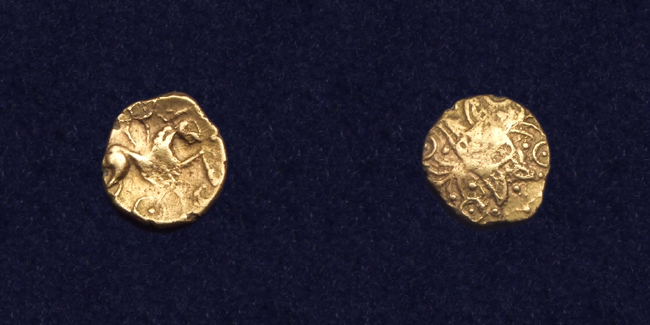
Gold quarter stater attributed to the Iceni, with a stylised horse motif.
The East Anglian Kingdom and Boudicca’s Revolt
Centred across modern Norfolk and the surrounding reaches of East Anglia, the Iceni, also recorded as the Eceni, carved out a distinct and powerful kingdom in eastern Britain. Following the Roman invasion of AD 43, they initially secured a peaceful alliance with Rome as a client kingdom under their pro-Roman king, Prasutagus. However, his death sparked a catastrophic turning point. When Roman officials violently seized his lands and abused his family, his widow, Queen Boudicca, unleashed a fierce tribal revolt in AD 60 or 61. Her rebel army swept through the province, completely destroying the major Roman centres of Camulodunum, Londinium, and Verulamium, and even crushing a detachment of the Ninth Legion, before the Roman governor Suetonius Paulinus finally managed to halt her uprising in a final, bloody battle.
Boars, Horses, and Tribal Inscriptions
The fierce independent streak of the Iceni is beautifully reflected in their silver and gold coinages, which their moneyers began producing by the middle of the first century BC. While early designs adapted the continental Gallo-Belgic traditions of highly stylised heads and galloping horses, the Iceni soon developed their own bold iconography. On several fascinating series, the traditional horse is entirely replaced by a wild boar, a powerful symbol of strength and warfare in Celtic culture. Crucially, a significant number of their coins proudly bear the explicit written legend ECENI, making this coinage one of the rarest examples where a British tribe stamped its own collective identity directly onto its money.
Trinovantes
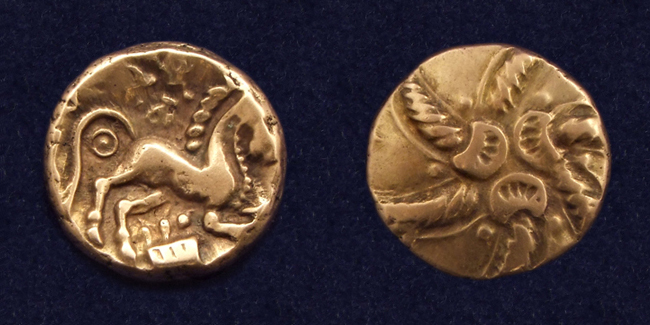
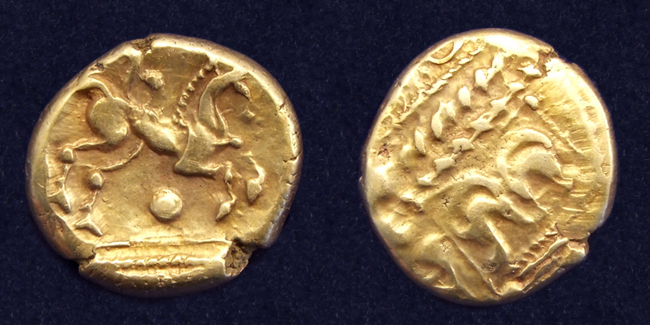
Gold stater, spiral type, attributed to the Trinovantes. Gold stater, Whaddon Chase type, from the North Thames region.
The Wealthy Estuary Kingdom and its Inscribed Coinage
The Trinovantes occupied a prosperous territory north of the Thames estuary, bordered by the Iceni to the north and the expansive Catuvellauni to the west. Their strategic coastal position allowed them to develop a highly organised regional economy centred on the great settlement of Camulodunum, modern Colchester. Towards the end of the first century BC, the prominent leader Addedomarus emerged as one of the very first British rulers to break with purely symbolic traditions and strike gold coinage bearing his own name. Although the exact chronology of his reign remains highly debated among modern historians, his spectacular spiral and Whaddon Chase type staters demonstrate a highly sophisticated minting system. The political landscape shifted rapidly as the century drew to a close, with Addedomarus being succeeded by Dubnovellaunus, before Camulodunum ultimately fell under the growing political influence of the neighbouring Catuvellauni.
Continental Celtic Tribes
Continental Celtic communities linked the Mediterranean and northern Europe. Their coinage, trade and alliances reveal close contact with the Greek and Roman worlds while preserving distinct local styles.
Ambiani
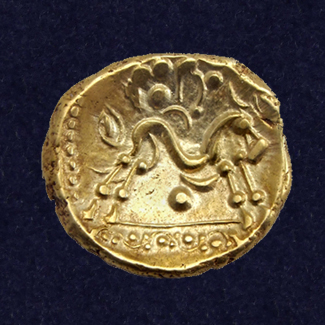
Uniface gold stater attributed to the Ambiani.
A Coastal Powerhouse Defying Julius Caesar
The Ambiani were a prominent coastal tribe settled along the lower reaches of the Somme valley in present-day Picardy, governing from their powerful tribal capital of Samarobriva, modern Amiens. Thanks to their strategic position linking continental trade routes with Britain, they grew into one of the most prolific and prosperous coin producers in northern Gaul. Their fierce political independence led them to play a monumental role in continental history. In 57 BC, the Ambiani joined a massive coalition of Belgic tribes to fiercely oppose the invading legions of Julius Caesar. This dramatic military alliance left a profound mark on the archaeological record, as the tribe minted immense quantities of gold to heavily finance the collective war effort and secure the vital services of foreign mercenaries.
From Apollo to the Blanco Gallic War Staters
The numismatic journey of the Ambiani offers one of the most fascinating studies in Celtic art history. Their earliest gold coinages closely imitated classical Greek designs, featuring a recognizable head of Apollo on the obverse and a galloping horse on the reverse. Over successive decades, native moneyers beautifully adapted this imagery, transforming realistic classical features into fluid lines, wild boars, and highly stylised abstract motifs. Some rare, enigmatic issues depict a stag alongside a figure wearing a sacred torc, which scholars interpret as a powerful tribute to Cernunnos, the ancient horned god of the wild. As the pressure of the Gallic Wars intensified, the design shifted dramatically, resulting in their famous uniface gold staters. These iconic coins feature a beautifully detailed horse on one side but leave the obverse entirely blank. This distinctive flat surface is widely believed to be the direct result of rapid wartime production, allowing minsters to strike thousands of coins quickly without wasting time engraving complex dies. These coins crossed the English Channel in huge numbers, circulating so widely across Iron Age Britain that they permanently altered the monetary development of the British tribes.
Lingones
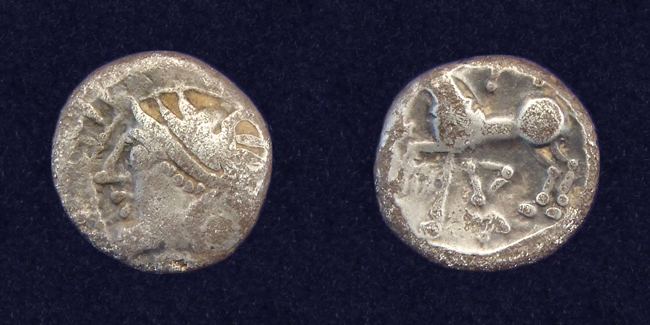
Kaletedou-type silver quinarius, traditionally attributed to the Lingones.
Territory and migration
The Lingones held a vast territory centred around modern Haute-Marne, reaching into parts of Côte-d’Or, Yonne and Aube. They lived alongside neighbours like the Senones, Leuci, Remi, Suessiones and Aedui. Their primary stronghold, Andematunnum, corresponds to present-day Langres. Around 400 BC, a branch of the tribe crossed the Alps to settle in Cisalpine Gaul within northern Italy.
Relations with Rome
Controlling key trade routes that linked the Mediterranean with western and northern Europe brought the tribe immense economic influence. During the Gallic Wars, the Lingones chose to ally with Caesar, mirroring the stance of the Aedui and Remi. They became heavily Romanised over the next century. This loyalty broke during the political turmoil of AD 69 and AD 70, when the Lingones joined forces with the Treveri under Julius Sabinus to revolt against Roman rule.
Kaletedou-type silver coins
The silver coinage traditionally linked to the tribe features the celebrated Kaletedou series, minted during the late second and first centuries BC. The obverse depicts a helmeted head inspired by the Roman goddess Roma, while the reverse shows a horse paired with a Greek legend. Scholars continue to debate the precise tribal attribution and the meaning behind these inscriptions.
Reverse legend varieties
- Type 1: SVLA KA ΛΕΤΕΔΟ V.
- Type 2: K A ΛΕΤΕΔΟ Y.
- Type 3: A shortened legend, occasionally appearing as ΚΑΛ, or faint remains of a pseudo-inscription accompanied by distinct symbols such as a wheel with multiple spokes, a pellet enclosed in a circle or an inverted delta.
Morini
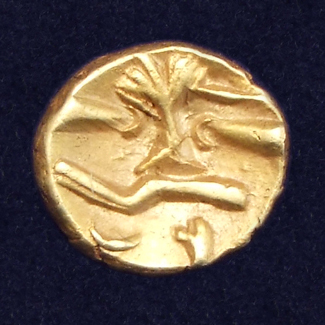
Uniface gold quarter stater traditionally attributed to the Morini, northern Gaul.
Coastal territory
The Morini were a Belgic people who settled across the coastal plains and wetlands of modern Pas-de-Calais, extending into neighbouring regions of northern France and western Belgium. Their coinage and tribal centres point to strong cross-Channel ties. Interestingly, the later name Flanders is widely thought to stem from a Germanic term that describes flooded land.
Caesar and Alesia
Caesar focused heavily on this maritime region because it provided the shortest sea route to Britain. Deep marshes and dense woodland allowed the Morini, alongside the neighbouring Menapii, to effectively hold off Roman legions. However, during the pan-Gallic uprising led by Vercingetorix in 52 BC, Caesar notes that the Morini were called upon to send 5,000 warriors to reinforce the relief army at Alesia.
A departure point for Britain
In 55 BC, Caesar gathered his fleet along the Morini coast ahead of his initial expedition to Britain. This strategic position thrust the coastal tribe directly into the heart of Roman military strategy. Seeking to secure his crossing, Caesar met with ambassadors from several Morini clans and demanded hostages before accepting their formal submission.
Labienus and the marshes
Upon his return from Britain, Caesar dispatched his trusted lieutenant Titus Labienus to subdue the Morini after they renewed hostilities. Roman accounts reveal that the wetlands which had protected the tribe the previous year had dried up, stripping them of their natural defences. This clash highlights how shifting seasonal conditions could quickly tip the scales between local resistance and Roman martial strength.
Remi
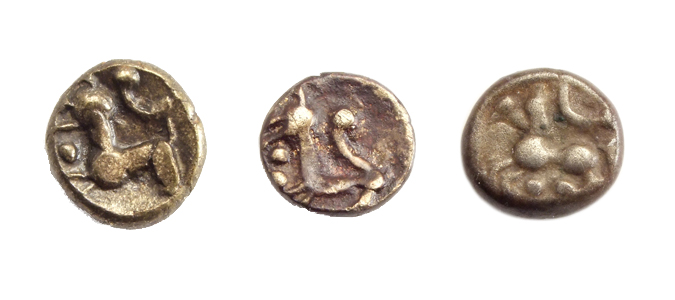
Examples of electrum quarter staters attributed to the Remi.
Territory and coinage
The Remi were a Belgic tribe of north-eastern Gaul. They occupied parts of the northern Champagne region, including the valleys of the Aisne and its tributaries, the Aire and Vesle. Their chief town was Durocortum, modern Reims. They were known for cavalry and horse-breeding, and their coinage includes electrum staters and quarter staters with animal and equestrian motifs.
Allies of Caesar
Under Iccius and Andecombogius, the Remi allied themselves with Julius Caesar during his conquest of Gaul. They remained loyal throughout the Gallic Wars and were among his most consistent supporters.
Iccius and the defence of Bibrax
In 57 BC, Iccius and Andecombogius represented the Remi in negotiations with Caesar, offering supplies and support while other Belgic tribes prepared to fight Rome. Iccius subsequently commanded the Remi town of Bibrax when it came under attack. Caesar records that he sent archers and slingers to reinforce its defenders, prompting the attackers to abandon their attempt to take the town.
A costly alliance
The alliance brought protection, but also obligations: Caesar required hostages from leading Remi families. The hostile Belgic army devastated their countryside after the attack on Bibrax. His account gives a vivid example of how tribal diplomacy affected both local leaders and ordinary communities during the Gallic Wars.
Explore further
Senones
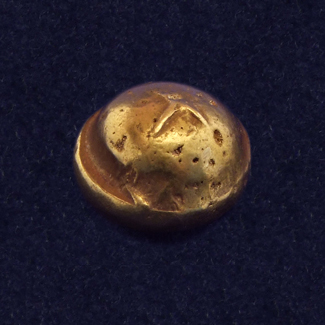
Gold stater, Gallo-Belgic bullet type, traditionally attributed to the Senones.
Gaul and Italy
The Senones were a Gallic tribe based around present-day Sens in the Seine and Yonne region. Some migrated into Italy during the early fourth century BC, settling along the Adriatic coast around Sena Gallica, modern Senigallia.
Conflict with Rome
The Italian Senones are associated with the sack of Rome, traditionally dated to 390 BC. Rome expelled them from their Italian territory in 283 BC. In 232 BC, the redistribution of former Senonian land contributed to renewed tensions with other Gallic peoples, preceding the invasion of 225 BC.
The Gallic Wars
The Senones who remained in Gaul later opposed Caesar. His account lists a quota of 12,000 Senonian troops for the relief army at Alesia in 52 BC. Their history illustrates the movement of Celtic groups across the Alps and their encounters with Etruscan and Roman communities.
Sequani
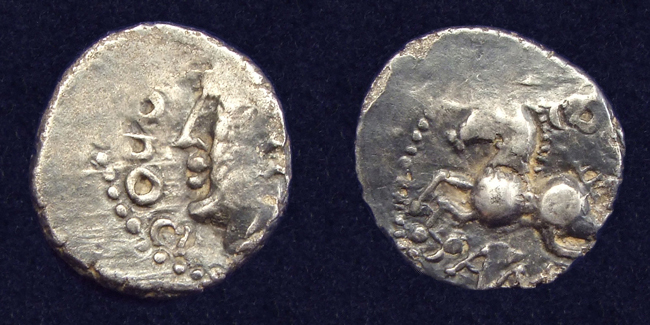
Silver quinarius attributed to the Sequani.
Territory and coinage
The Sequani occupied the upper basin of the Arar (Saône), the Doubs valley and the Jura Mountains, in an area corresponding broadly to Franche-Comté and part of Burgundy. Their silver coinage includes quinarii influenced by Roman coin types and denominations.
Changing alliances
The Sequani initially enlisted Ariovistus against their rivals, the Aedui, but his growing power subsequently threatened their own territory. Caesar intervened against Ariovistus in 58 BC. The Sequani later joined the resistance led by Vercingetorix.
The relief of Alesia
In 52 BC, Caesar records that the Sequani were required to supply 12,000 men to the relief army at Alesia. The Senones were assigned a separate contingent of the same size.
Explore further
NumisAntica images in publications
Examples from our collection have been illustrated in articles and reference pages. Explore our Media & Publications page for articles using our Celtic images.
Coin captions follow traditional attributions where appropriate. Tribal attributions and chronologies can vary between catalogues and remain subjects of research.